Showing posts with label pepper. Show all posts

Saturday, March 26, 2011

Kampot Trip - Part 6 - Salt and Pepper

On our last morning in Kampot, when Rotha pulled up in the tuk-tuk to take us on the Salt & Pepper tour, things started to make sense.  Two evenings before, when faced with two exhausted and unsuspecting tourists (us), Rotha had seized a golden opportunity - He'd taken our $36, written us a bogus ticket for the tour, and borrowed or rented  a tuk-tuk to drive us around so he could pocket the profits.  Now, as we loaded our bags into the tuk-tuk we knew it, and he knew that we knew it.  Perhaps that's why he didn't speak more than twenty words the entire day, and although we'd paid for a guided tour, we ended up with a high-priced tuk-tuk ride to all the places listed in the tour brochure.

On the first leg of our ride, we passed through an area which appeared to be primarily populated by Muslims.  We'd seen some ladies in the Kampot market wearing head coverings, but weren't aware that this part of Cambodia is also home to many people who adhere strictly to Islam and the garb of their faith.  Riding past small villages, we saw women dressed completely in black robes with only their eyes showing, men and boys in white robes and caps, and a very elaborate mosque. 

Muslim man off to the far right

Mosque

We turned off the road at a sign indicating a pepper plantation with restaurant, bar and tours, but this wasn't  to be our destination.  Instead, Rotha took us to a small roadside plantation where a few people sat in the shade of a small rotunda while a monk, stripped to the waist, slugged away outside, digging up some ground in the hot sun.  I'm still not sure what the monk was doing or why, but it just struck me as curious.

A few steps away was a small pepper plantation, where we were fortunate to meet a young boy  eager to practice his English, who explained all about pepper cultivation.  We were amazed to learn that pepper plants have a vine-like growth habit, and some plants can be as old as 30 years.  Pepper grows in grape-like clusters.  The corns are green and hard at first, then as they mature, they form a red fruit over a large white seed, (similar to a chokecherry, I thought).  We learned that black pepper is made by drying the green peppercorns, red pepper comes from dried whole red peppers, and white pepper is produced by removing the outer red fruit, and washing and drying the remaining white seed.  

Kampot pepper is considered to be one of the best and most exotic in the world.  During the time of the Khmer Rouge, production was halted, and all but died off.  Currently, Kampot produces about 4,000 tonnes of pepper a year, and if you buy it anywhere else except Cambodia, it's pretty expensive.  Check out the prices and descriptions by clicking >>> here<<<
This young man knew a lot about pepper production

The young pepper plants are started from cuttings from the mature plants
These ones are about 3 months old
The hole next to the plant is for water

Nearly mature pepper plants, about 3 years old
As they mature, they are watered between the rows only

Can you see the clusters of green peppercorns?

The peppercorns turn red

After making or purchases, we hopped back into the tuk-tuk, again with no inkling of our next stop until we got to the salt flats.  There wasn't a soul around, nobody to give us any information, so it's a good thing Gordon knew something about how salt is produced from seawater.  
As far as the eye could see, there were square pools of water.
When the tide comes in, a gate is opened to flood the pools,
then it is closed to prevent the water from returning to the sea.
The seawater is then evaporated by the sun and the salt is collected

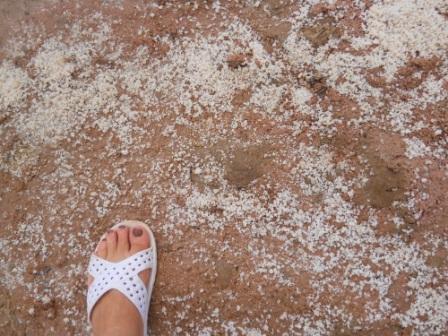
Salt crystals on the ground

Salt crystals are dirty and mixed with sand

There were many storage shacks like this one, filled with salt

Mounds of salt inside the shack

We wandered around the fields for a while, marveling in the wonders of nature, and the ingenuity of man.  It would have been interesting to know what happens to the salt, how it's harvested, where it's refined and sold.  That's another subject for a google seach, I suppose.

We hopped back into the tuk-tuk, with no idea where we were headed from there, until we arrived in Kep.  Once a bustling seaside resort, Kep was almost entirely abandoned during the reign of the Khmer Rouge.  Many buildings still lay in ruins.


We continued toward the seaside, where vendors sold their wares, mostly handmade.  I bought a few trinkets and some sweet treats, all for mere pennies.

Along the road, a horse cart

Kep Beach

I dipped my toes in the Indian Ocean

Buying some trinkets

Twenty small packets of sticky rice for about 50 cents

Yummy treat inside, still warm....

It was lunchtime, perfect time to head to the market for some fresh seafood. 
All kinds of seafood for sale - fresh, salted, dried.....

Gordon went for the grilled squid,
but I couldn't look another fish in the eye at that point...

More trinkets

I settled on half a jackfruit....

And yes.... I ate the whole thing....Delicious!


Being in Kep for such a brief period left us wishing we'd had more time to spend there, exploring or just walking on the beach, but we were watching the time, and with only a few more hours before we boarded the bus back to Siem Reap, we jumped back into the tuk-tuk, expecting to head straight back to Kampot.

We turned down a road with a sign pointing to Phnom Sosir Resort, and Rotha stopped at the foot of a long set of stairs leading to a temple.  Seeing the stairs, Gordon held back, thinking his knees wouldn't take the climb, but I forged ahead.  At the base of the stairs, I passed a man who followed me up.  At the top, he showed me stairs that led up further to a cave shrine.
Stairs up to the temple - I love the soft pastels

A monk contemplating in the shade

As we passed this on the way to the cave,
the man pointed and said 'Holy Cow'.
I replied 'We have the same saying in my country'.
I bet he thought I was nuts...

At the cave entrance was a steep narrow set of steps descending into the cave.  There was no handrail and the stairs seemed to drop off into nothingness.  I took a few steps down, felt my knees buckling, and had to turn back.  Vertigo had won.  Whatever beauty was in the depth of that cave would have to wait for the next visitor.

Sunday, March 6, 2011

Kampot Trip - Part 1 - Getting There

One of our favourite Khmer dishes is Lok lak.  The secret ingredient for producing the tastiest Lok lak dipping sauce is Kampot pepper, grown only in.... (you guessed it).... Cambodia!   Selling around the world for at least $19 an ounce, Kampot pepper is considered to be the 'champagne of peppers'.  You can't come all the way here and not buy some, so we set off last Wednesday on a wild adventure to the town of Kampot (in Kampot Province) - Gordon wanted to make sure we were getting the real deal.


Throughout Cambodia, bus travel is surprisingly inexpensive.  For the first leg of our journey from Siem Reap to Phnom Penh, we opted for express mini-van service, featuring luxurious seating and a comfortable ride - a bargain at $8 per person.  The operative word here is 'express'.  The driver flew along the highway at breakneck speed, leaning on the horn every two minutes to warn everybody to get out of his way.  Apparently he was either late for a hot date, or preparing for his debut in the Indy 500. 
Gordon waiting to board the express mini-van
The passenger behind him is from Paris.
We boarded the mini-van at 6:45 and were given a boxed breakfast -
Fresh sweet roll and bottled water
 
During our 'rest stop', I chatted in French with an interesting man who, at the age of 15, fled to France from Cambodia in 1979, after the Pol Pot regime.  When this man, who drives taxi in Paris for a living, also expressed his concerns about the driving, I really began to wonder how safe we were.  Obviously I wasn't the only passenger with white knuckles.  Fortunately we arrived in Phnom Penh intact - a full hour ahead of schedule. 
Mini-van driver cooling off the engine

I've never had a strong desire to visit Phnom Penh, mainly because I don't care much for big cities.  I've also heard a lot about the crime and drug problems there, and I prefer to avoid trouble when I can, but here we were in the midst of it.  We were immediately swarmed by tuk-tuk drivers eager for a fare.   At this point, choice became a matter of 'eeny-meeny-miney-moe', and we picked one... who charged us $6 to get to the 'other' bus station, six kilometers away!  Seeing as we'd just paid $8 each to get all the way from Siem Reap to Phnom Penh in a luxury bus, $6 did seem a little outrageous.  However, we'd only bought our ticket to Phnom Penh and had no idea what time the next bus to Kampot would leave, or even how to get to the bus station, so we were in no position to argue or negotiate prices. 


The tuk-tuk sped through the city, past markets, tall buildings, and people.  Lots of people.  Lots of motos.  Lots of bicycles.  I can only describe Phnom Penh as 'Siem Reap on steroids', except that Phnom Penh has large office buildings and not as many resort hotels.  Everywhere there were lots of tourists, and lots of Cambodians, doing what tourists and Cambodians do, only more of it.  Same crazy traffic, with one difference - Pedi-cabs.  Same crazy traffic patterns.  Our driver didn't even blink when he rode past the 'Do not enter' sign and went the wrong way down a one-way street. 
Market stall in Phnom Penh
Birdhouses or spirit houses??

Pretty lady wearing a hat and a helmet

Pedi-cab!

Crazy traffic!

Yep, 'Do Not Enter'!

At the bus station, we learned we'd have to wait three hours for the bus to Kampot.  (It could have been worse - we might've had to spend the night in Phnom Penh.)  The tuk-tuk driver tried to convice us to go to the Killing Fields rather than wait at the station and offered to drive us there for $15 round trip.  When we learned the entrance was an additional $20, we decided to take a pass.  (We'd already been to the Killing Caves, which had been emotionally draining enough for me.)    Instead we decided to look for a restaurant to eat lunch.  We walked up and down the street three or four blocks each way, but other than street food, we could not find a place to eat.  We returned to the bus station and had fun observing the Cambodian men who hung out there playing chess.  In another corner, about ten men gathered round an old TV, totally engrossed in an American movie which was dubbed in Cambodian, with English subtitles.  The bus station is situated in a part of Phnom Penh not frequented by foreigners at all.  The only barangs we saw were a couple of girls waiting for a bus to Sihanoukville.

A chicken was tied onto one of these bags
waiting to board the bus.
I wonder if it rode in the bus or the baggage compartment?

Gathered around watching TV at the bus station


Finally we boarded the bus to Kampot.  It was an interesting ride that took us through several small villages and through the seaside town of Kep.  Just as the sun was setting around 6:30, we arrived in Kampot.  It had been a 12-hour journey, and the real adventures hadn't even started yet! 


Sign on the bus to Kampot
The bus had a TV screen with Cambodian karaoke
Next they played a very bad movie dubbed in Khmer
that ran through three times.....yawn...